A Molecular Visualization on Pain Sensitization in Inflammatory Bowel Disease
The Silent Burden
Description
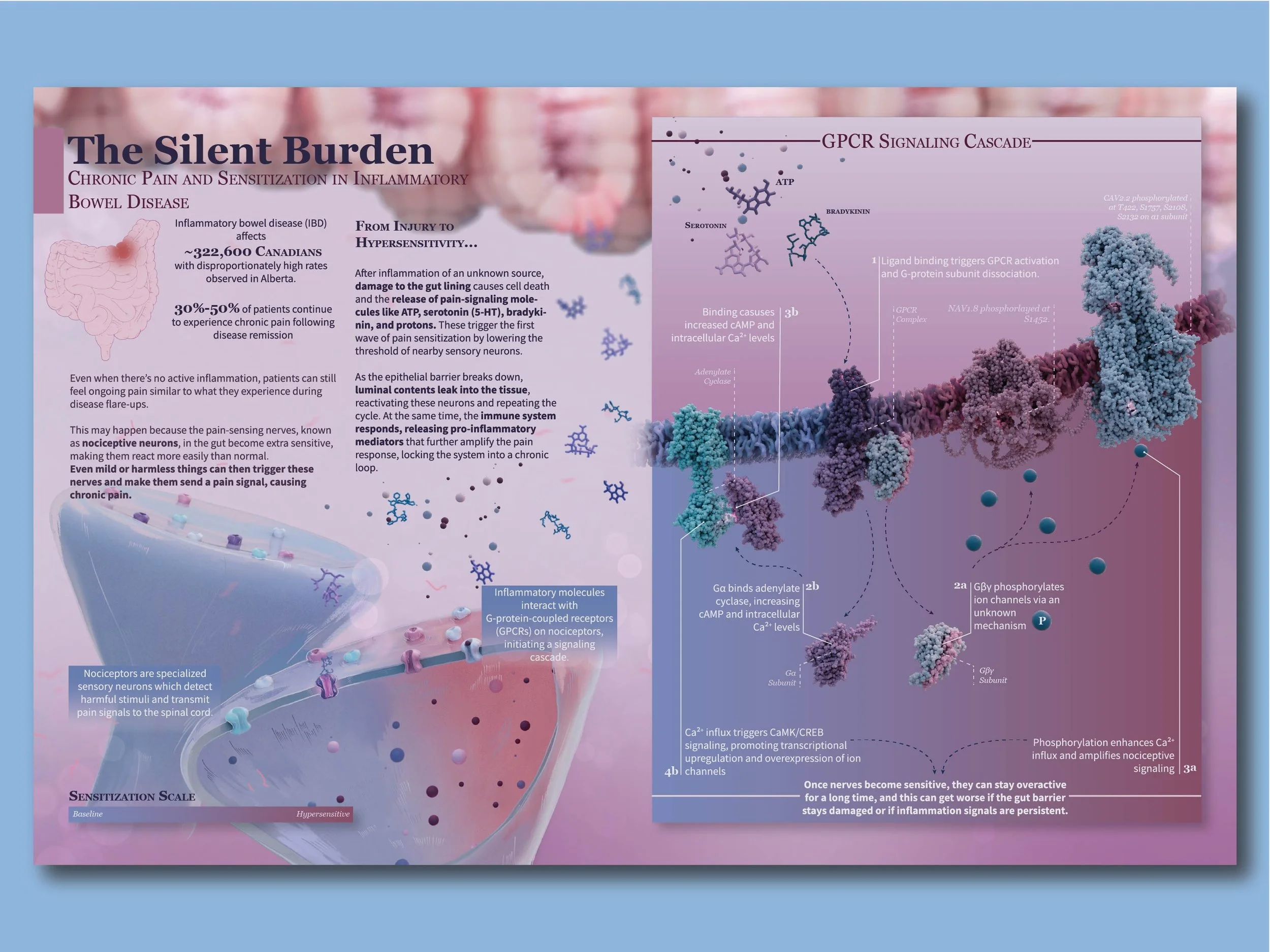
This two-page magazine spread features a detailed molecular visualisation designed to highlight the mechanisms of pain sensitisation in inflammatory bowel disease (IBD). The artwork captures the complex interaction between molecules released due to cell death and nociceptors, emphasising how chronic inflammation triggers a heightened pain response. The visualisation also highlights the cyclical nature of IBD pain: ongoing inflammation perpetuates nerve activation, which in turn exacerbates inflammation, creating a self-sustaining loop of discomfort and tissue damage. This representation aids in understanding how interrupting this vicious cycle could be key to developing targeted therapies for pain relief in IBD patients.
Tools
ChimeraX, VMD, Z-Brush, Maya, and Illustrator
Type of Work
Assignment
Approach
2 page magazine spread
Client
Dr Derek Ng (University of Toronto)
Year
2025
Audience
General
Research and Ideation
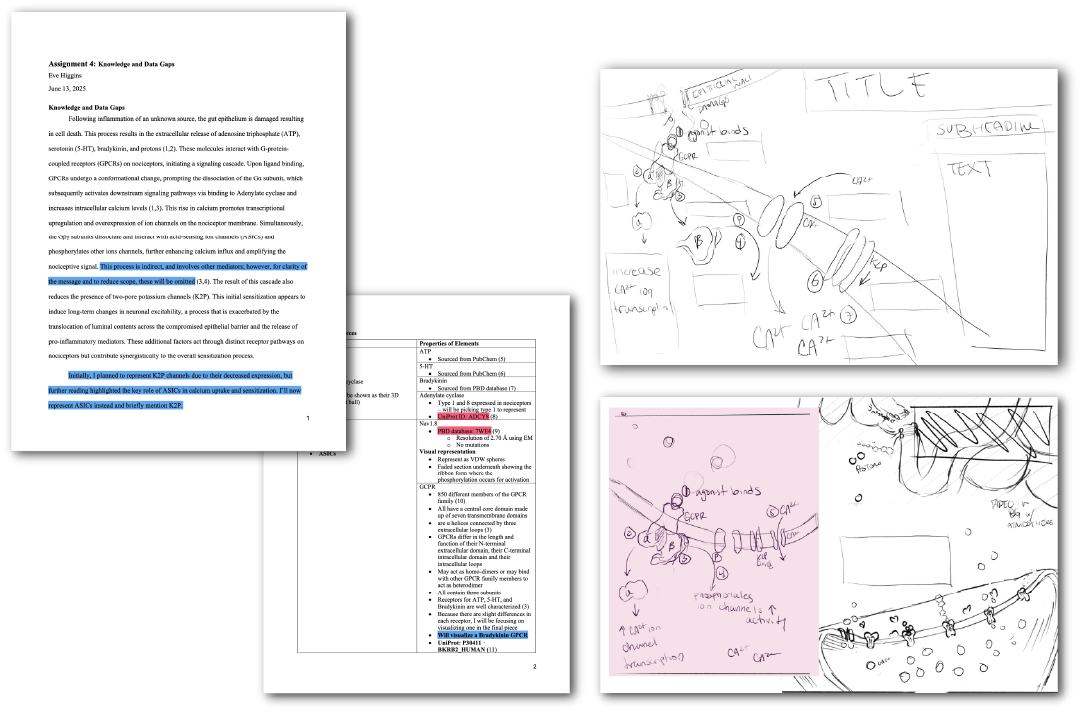
After selecting my topic, I conducted thorough research, gathering relevant scientific literature and data to establish a solid foundation. I engaged in multiple ideation sessions, revisiting and refining concepts to enhance clarity and accuracy. Throughout this process, I consulted with peers and content experts to gain diverse perspectives and ensure the visual representations aligned with current scientific understanding. This iterative approach allowed me to develop visuals that effectively communicate complex information while maintaining scientific integrity.
Production
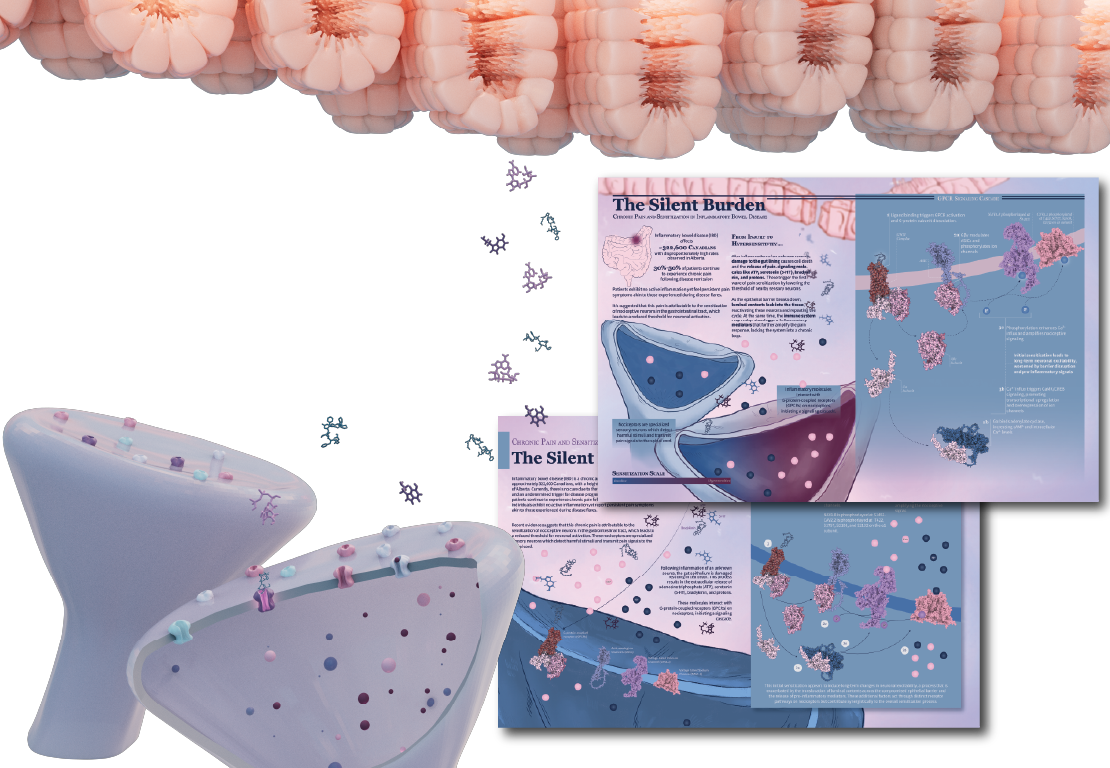
The process involved taking the PDB files and first cleaning them in ChimeraX to prepare the molecular structures for visualization. These cleaned files were then exported as .OBJ formats and imported into Maya, where the scene was meticulously constructed to ensure accurate spatial relationships. Additional assets, including neurons, epithelial cells, and ion channels, were sculpted separately in ZBrush to add detailed organic forms. Finally, the composite image was assembled and refined in Illustrator to produce a polished and scientifically precise final illustration.
References
Background information, Page 1:
Impact of IBD in Canada Report - Impact of IBD in Canada Report - Crohn’s and Colitis Canada. Available from: https://crohnsandcolitis.ca/About-Us/Resources-Publications/Impact-of-IBD-Report
Szigethy E. Pain Management in Patients With Inflammatory Bowel Disease. Gastroenterol Hepatol (N Y). 2018 Jan;14(1):53. Available from: https://pmc.ncbi.nlm.nih.gov/articles/PMC5824598/
Brierley SM, Linden DR. Neuroplasticity and dysfunction after gastrointestinal inflammation. Nature Reviews Gastroenterology & Hepatology 2014 11:10. 2014 Jul 8;11(10):611–27. Available from: https://www.nature.com/articles/nrgastro.2014.103
Grundy L, Erickson A, Brierley SM. Visceral Pain. Annu Rev Physiol. 2019 Feb 10;81(Volume 81, 2019):261–84. Available from: https://www.annualreviews.org/content/journals/10.1146/annurev-physiol-020518-114525
Signaling Cascade, Page 2:
Brierley SM, Linden DR. Neuroplasticity and dysfunction after gastrointestinal inflammation. Nature Reviews Gastroenterology & Hepatology 2014 11:10. 2014 Jul 8;11(10):611–27. Available from: https://www.nature.com/articles/nrgastro.2014.103
Molliver DC. G-Protein Coupled Receptors in Sensory Neuron Function and Pain. Encyclopedia of Neuroscience. 2009;1761–5. Available from: https://link.springer.com/rwe/10.1007/978-3-540-29678-2_2070
Gribkoff VK. The role of voltage-gated calcium channels in pain and nociception. Semin Cell Dev Biol. 2006 Oct 1;17(5):555–64. Available from: https://www.sciencedirect.com/science/article/abs/pii/S1084952106000991
Small Molecules Used:
ATP, sourced from PDB Database
RCSB PDB - ATP Ligand Summary Page. Available from: https://www.rcsb.org/ligand/ATP
5-HT, sourced from PubChem Serotonin | C10H12N2O | CID 5202 - PubChem. Available from: https://pubchem.ncbi.nlm.nih.gov/compound/5202
Bradykinin, sourced from PDB database: ID 7F6H RCSB PDB - 7F6H: Cryo-EM structure of human bradykinin receptor BK2R in complex
Gq proteins and bradykinin. Available from: https://www.rcsb.org/structure/7F6H
Proteins Used:
Adenylate cyclase, sourced from UniProt: ID ADCY8. Currently trying to find how it binds to the Gα subunit.
ADCY8 - Adenylate cyclase type 8 - Homo sapiens (Human) | UniProtKB | UniProt. Available from: https://www.uniprot.org/uniprotkb/P40145/entry#structure
Nomura, R., Suzuki, S., Nishikawa, K., Suzuki, H., & Fujiyoshi, Y. (2025). Structural insights into human adenylyl cyclase 9 in complex with Gαs by Cryo-EM. Journal of Structural Biology, 217(3), 108223. https://doi.org/10.1016/j.jsb.2025.108223 RCSB PDB - 9U3R: Cryo-EM structure of human AC9. Available from: https://www.rcsb.org/structure/9U3R
Nav1.8, sourced from PBD database: ID 7WE4 and its phosphorylation sites for activation.
RCSB PDB - 7WE4: Human Nav1.8 with A-803467, class I. Available from: https://www.rcsb.org/structure/7WE4
Wu DF, Chandra D, McMahon T, Wang D, Dadgar J, Kharazia VN, et al. PKCε phosphorylation of the sodium channel NaV1.8 increases channel function and produces mechanical hyperalgesia in mice. J Clin Invest. 2012 Apr 2;122(4):1306–15. Available from: http://www.jci.org
Heinle JW, Dalessio S, Janicki P, Ouyang A, Vrana KE, Ruiz-Velasco V, et al. Insights into the voltage-gated sodium channel, NaV1.8, and its role in visceral pain perception. Front Pharmacol. 2024 May 23;15:1398409.
Bradykinin binding GPCR, sourced from PBD database: ID 7F6H.
RCSB PDB - 7MIY: Human N-type voltage-gated calcium channel Cav2.2 at 3.1 Angstrom resolution. Available from: https://www.rcsb.org/structure/7MIY Shen J, Zhang D, Fu Y, Chen A, Yang X, Zhang H. Cryo-EM structures of human bradykinin receptor-Gq proteins complexes. Nat Commun. 2022 Dec 1;13(1).
Geppetti P, Veldhuis NA, Lieu TM, Bunnett NW. G Protein-Coupled Receptors: Dynamic Machines for Signaling Pain and Itch. Neuron. 2015 Nov 18; 88(4):635–49. Available from: https://www.sciencedirect.com/science/article/pii/S0896627315009800#fig5
CaV2.2, sourced from PBD Database: ID 7MIY and its phosphorylation sites for activation.
RCSB PDB - 7MIY: Human N-type voltage-gated calcium channel Cav2.2 at 3.1 Angstrom resolution. Available from: https://www.rcsb.org/structure/7MIY
Lacinova L, Mallmann RT, Jurkovičová-Tarabová B, Klugbauer N. Modulation of voltage-gated CaV2.2 Ca2+ channels by newly identified interaction partners. Channels. 2020 Jan 1;14(1):380. Available from: https://pmc.ncbi.nlm.nih.gov/articles/PMC7567506/