Mechanism of Injury to Facial Bones
Description
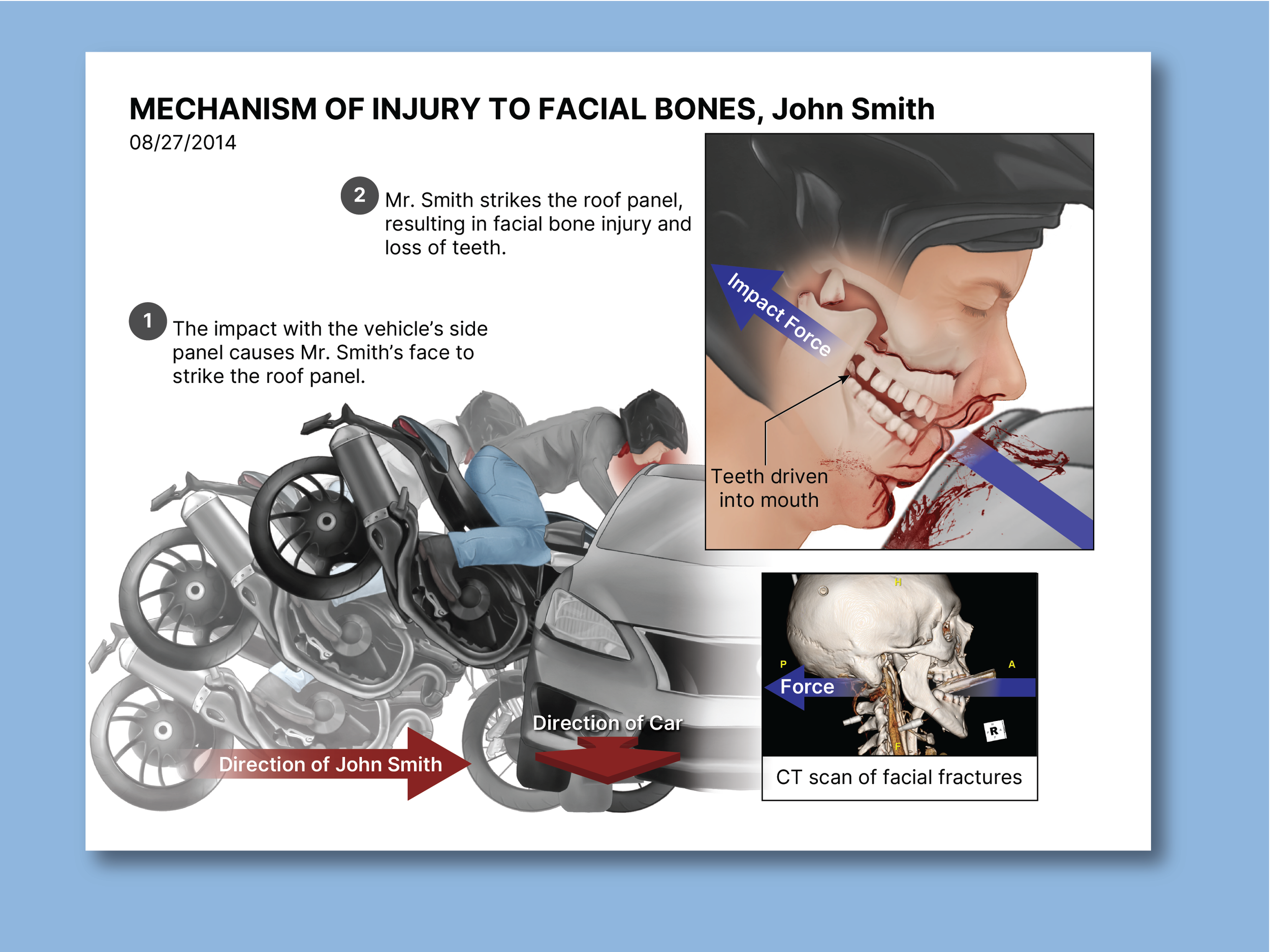
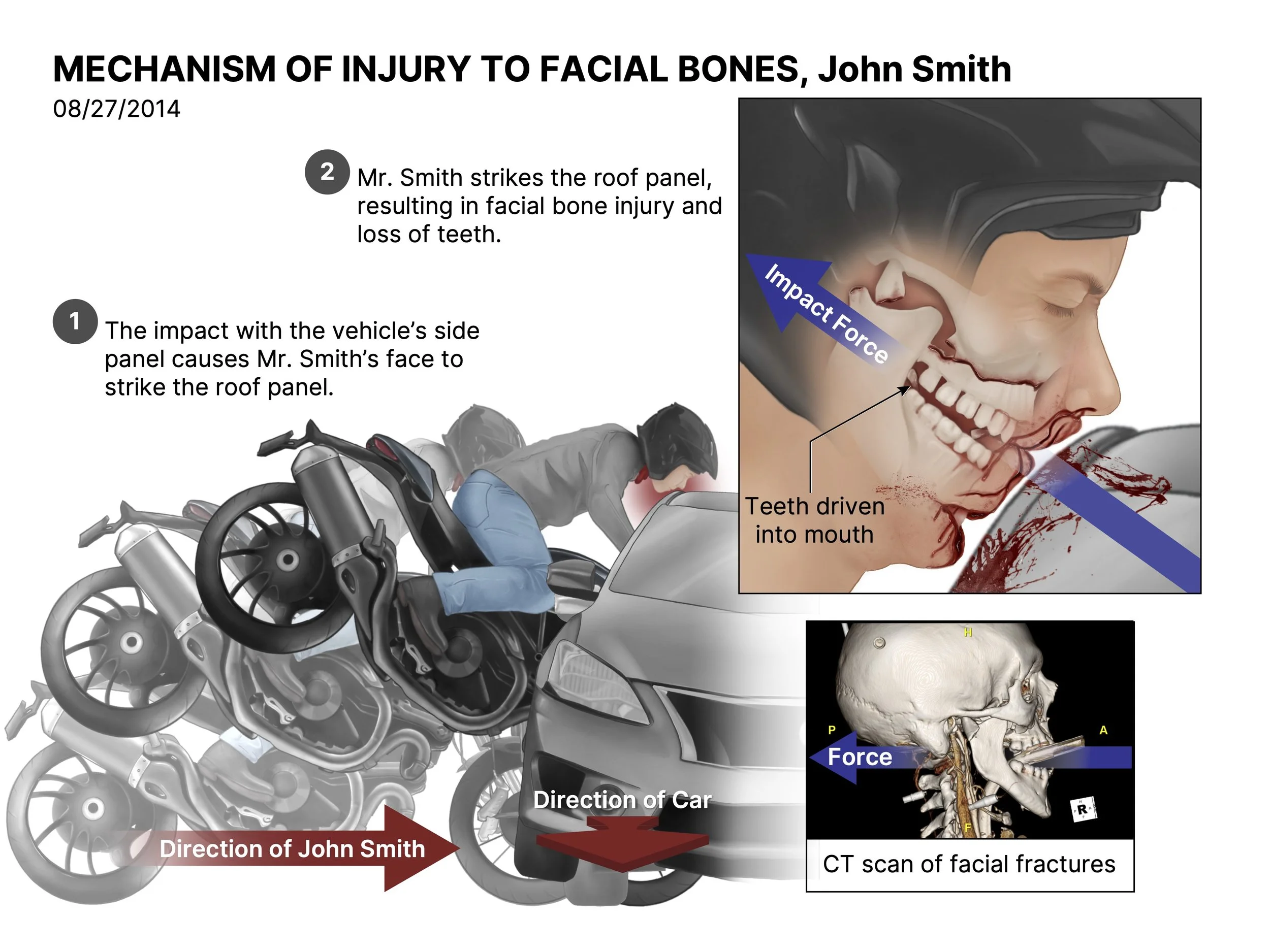
I prepared an exhibit illustrating the mechanism of injury for our ‘client’, representing John Smith, depicting the motorcycle striking the car's panel with an inset showing the precise moment of impact that caused the facial bone fractures. Because the incident report did not describe how the motorcycle contacted the vehicle, I had to research vehicle dynamics and typical motorcycle–car impact angles to determine plausible trajectories and contact points; that reconstruction informed the positioning and force vectors in the illustration. Level of soft-tissue trauma was carefully discussed with clinical experts, since many published references document findings from minutes to hours post‑injury rather than the immediate post‑impact appearance, so expert input guided interpretation of acute swelling, laceration patterns and tissue displacement. I also incorporated the CT scan into the exhibit to anchor the bony injury depiction to objective imaging, enhancing the exhibit's credibility and ensuring the visual narrative matched both biomechanical reconstruction and the medical evidence.
Client
Stephen Mader (Prof. University of Toronto)
Year
2025
Audience
Jury (Lay Audience)
Tools
Procreate, Illustrator
Type of Work
Coursework
Approach
Litigation Exhibit
Research and Ideation
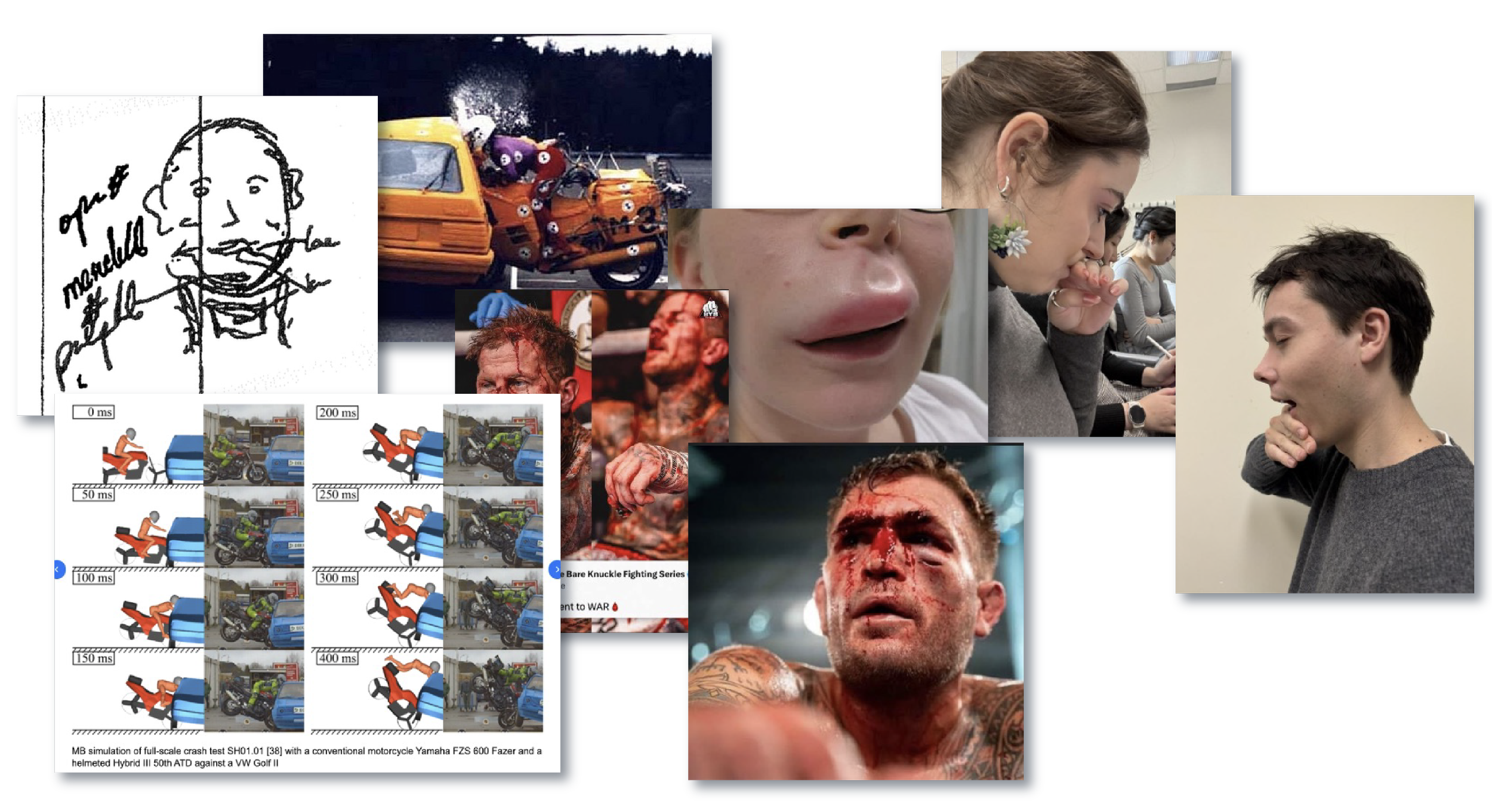
I conducted detailed research to determine how the motorcycle would have impacted the car, assessing whether the contact would have been primarily against the windshield or a body panel by examining relative impact angles and deformation patterns; concurrently, I reviewed literature on boxing injuries to understand immediate soft-tissue trauma, typical patterns of swelling, and variations in blood consistency and colour following blunt facial impact. To accurately portray facial distortion from compression against a flat surface, I used photo references of myself and friends in controlled poses to observe how soft tissues displace, skin folds, and pressure points form. I integrated those observations with biomechanical and clinical sources to produce a realistic, medically informed depiction.
Production
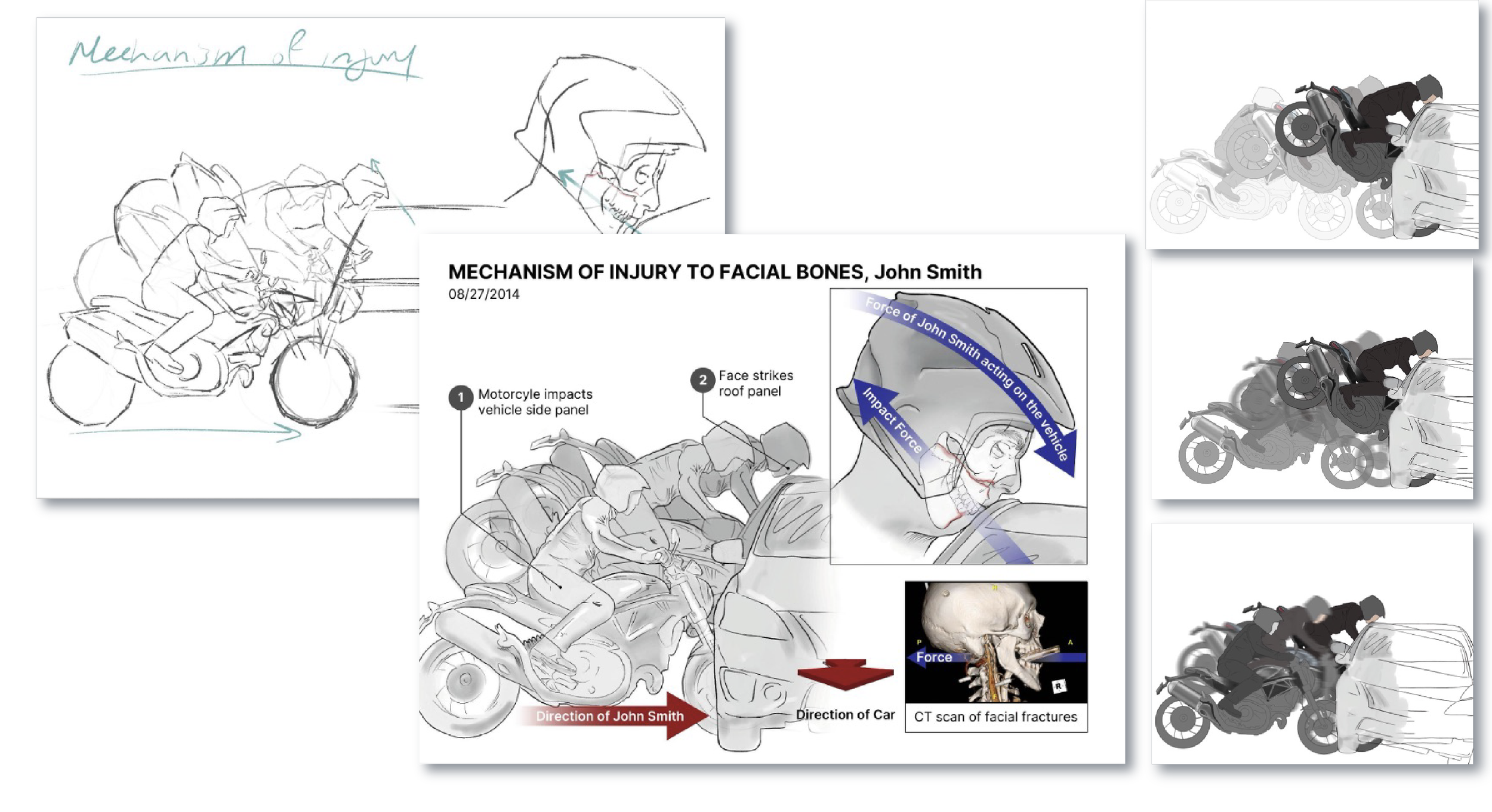
From the beginning, I knew I wanted to include the motorcycle colliding with the car, with a tight zoom on the break point; this decision set the visual and narrative priorities for the panel. The main challenge was conveying the force and sequence of impact within a very small section of the composition without losing clarity or emotional weight. I tackled this through iterative sketches and value studies, testing different framings, motion lines, and focal blurs to suggest speed and deformation, and refining the timing across a few key frames so the viewer reads the event instantly. Each pass simplified extraneous detail, emphasised decisive shapes at the moment of contact, and adjusted contrast and scale to make the break point the unequivocal focal element while preserving context around the collision.