Description
This project is an infographic explaining the segmentation clock, a complex concept in regenerative medicine, in a clear and engaging way. The layout draws inspiration from magazines like Scientific American, making the topic approachable for readers who are interested in science but not familiar with this area of research. Using visual storytelling, the fold-out design breaks down how the segmentation clock works and why it matters. It also connects current research to clinical trials as of February 2025, giving context for how these advances could influence future therapies.
Client
Shehryar Saharan (Prof. University of Toronto)
Year
2025
Audience
Scientists
Tools
Maya, Procreate, Illustrator
Type of Work
Coursework
Approach
Magazine spread with fold out
Research and Ideation
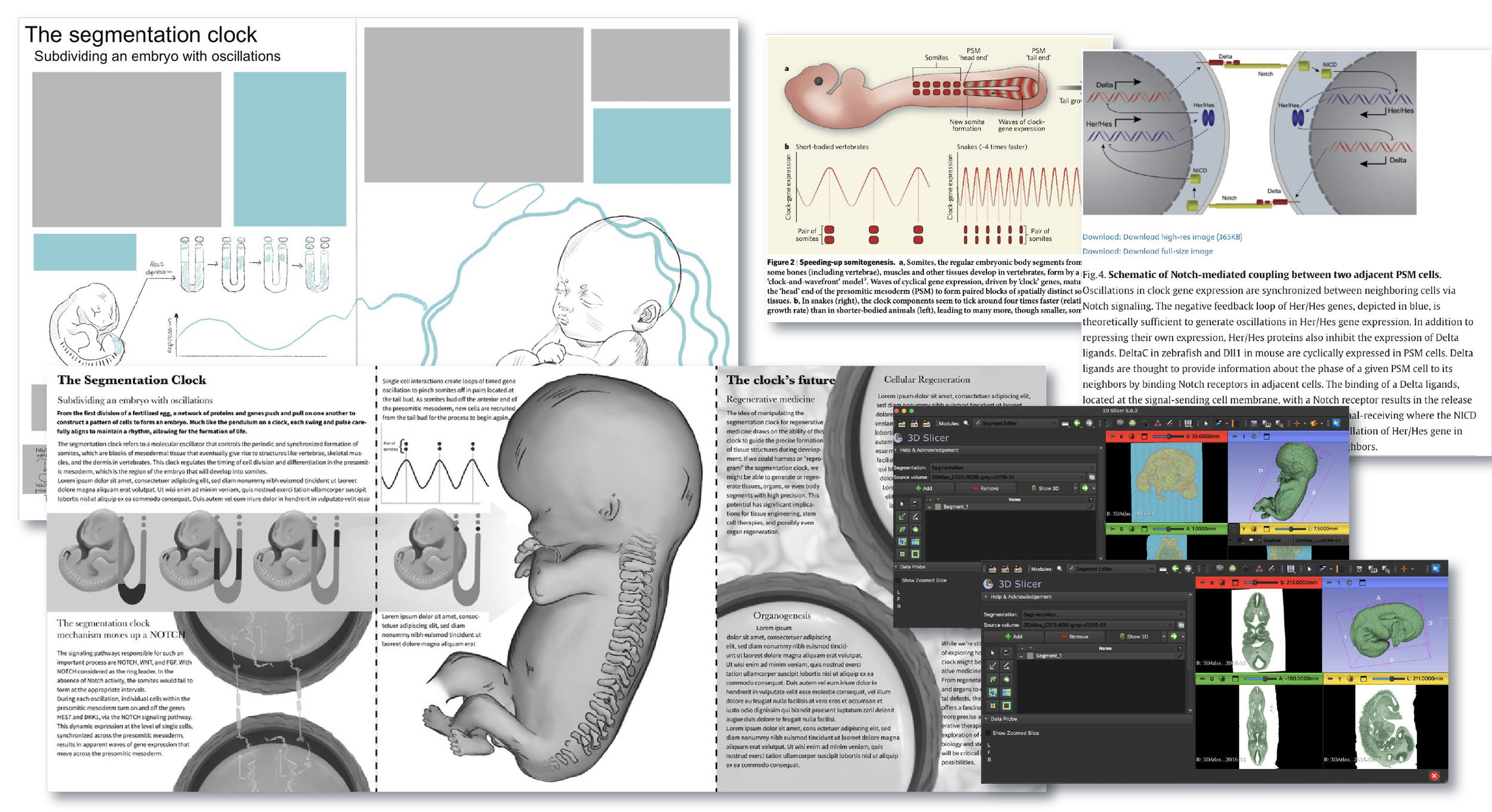
Research informed every stage of the design process, with scientific discovery and visual exploration evolving in parallel. Rather than treating research as a preliminary step, insights gathered from the literature continually shaped the hierarchy, pacing, and composition of the infographic. As key concepts surrounding the segmentation clock emerged, the information architecture was refined to create a visual narrative that guides viewers through an inherently complex developmental process while reducing cognitive load.
To ensure scientific accuracy, I incorporated volumetric datasets from the 3D Embryo Atlas into 3D Slicer, reconstructing embryonic anatomy to better understand spatial relationships throughout development. These anatomical references became a foundation for the final illustrations, allowing complex three-dimensional structures to be translated into clear, intuitive visual explanations. By combining evidence-based research with iterative design, the final infographic balances scientific precision with visual clarity, making developmental biology more accessible without sacrificing accuracy.
Production
The production process combined 3D visualization with digital illustration to balance anatomical accuracy with visual communication. Anatomical reconstructions created in 3D Slicer were refined in Autodesk Maya, where lighting, colour, and materials were carefully developed to enhance depth, establish visual hierarchy, and direct the viewer's attention. Rather than serving as final artwork, these renders functioned as a structural foundation, capturing spatial relationships while removing visual complexity that could distract from the core message.
The rendered images were then digitally painted over to simplify forms, unify the visual language, and create a more approachable aesthetic. This hybrid workflow leveraged the precision of 3D data alongside the flexibility of illustration, resulting in visuals that communicate complex developmental biology with both scientific integrity and clarity. Every production decision was guided by a single goal: making intricate anatomy easier to understand without compromising its accuracy.
References
Ajmal, L., Ajmal, S., Ajmal, M., Nawaz, G., Ajmal, L., Ajmal, S., Ajmal, M., & Nawaz, G. (2023). Organ Regeneration Through Stem Cells and Tissue Engineering. Cureus, 15(1). https://doi.org/10.7759/CUREUS.34336
Alliance for Regnerative Medicine. (2025). Clinical Trials by Therapeutic Approach - 2024 Q4.
Baldwin, C., Kim, J., Sivaraman, S., & Rao, R. R. (2022). Stem cell-based strategies for skeletal muscle tissue engineering. Journal of Tissue Engineering and Regenerative Medicine, 16(12), 1061–1068. https://doi.org/https://doi.org/10.1002/term.3355
Diaz-Cuadros, M., Wagner, D. E., Budjan, C., Hubaud, A., Tarazona, O. A., Donelly, S., Michaut, A., Al Tanoury, Z., Yoshioka-Kobayashi, K., Niino, Y., Kageyama, R., Miyawaki, A., Touboul, J., & Pourquié, O. (2020). In vitro characterization of the human segmentation clock. Nature, 580(7801), 113–118. https://doi.org/10.1038/s41586-019-1885-9
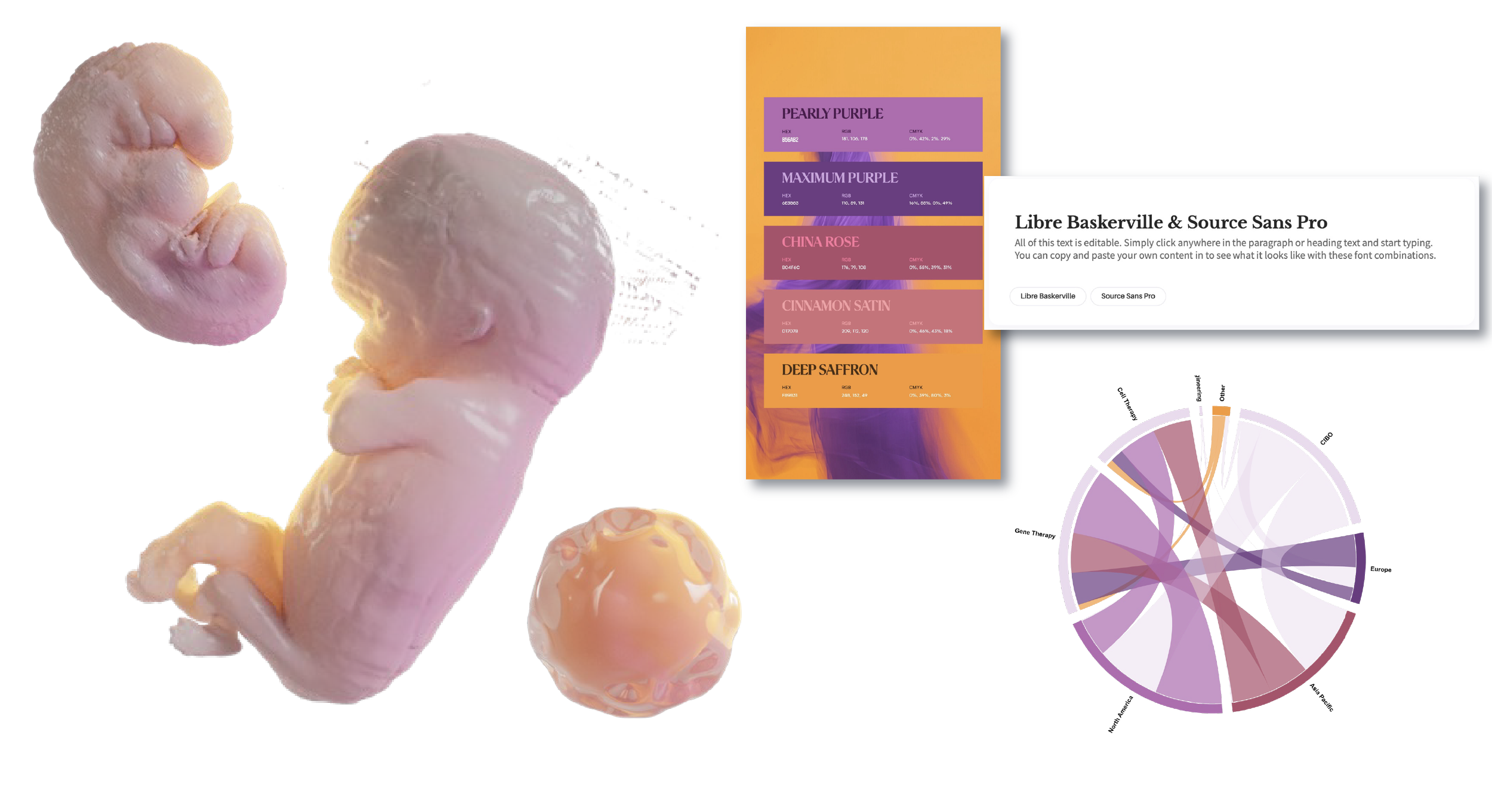
FontPair.co. (n.d.). Retrieved February 25, 2025, from https://www.fontpair.co/pairings/libre-baskerville-source-sans-pro
Gibb, S., Maroto, M., & Dale, J. K. (2010). The segmentation clock mechanism moves up a notch. Trends in Cell Biology, 20(10), 593–600. https://doi.org/10.1016/j.tcb.2010.07.001
Home | 3datlas. (n.d.). Retrieved February 4, 2025, from https://www.3dembryoatlas.com/
Infographics - Mesa Schumacher. (n.d.). Retrieved February 25, 2025, from https://www.mesaschumacher.com/infographic-projects/
Kwan, M. D., & Longaker, M. T. (2008). Regenerative Medicine: The Next Frontier. Transplantation, 86(2). https://journals.lww.com/transplantjournal/fulltext/2008/07270/regenerative_medicine__the_next_frontier.6.aspx
Maroto, M., Bone, R. A., & Dale, J. K. (2012). Somitogenesis. Development, 139(14), 2453–2456. https://doi.org/10.1242/dev.069310
Matsuda, M., Yamanaka, Y., Uemura, M., Osawa, M., Saito, M. K., Nagahashi, A., Nishio, M., Guo, L., Ikegawa, S., Sakurai, S., Kihara, S., Maurissen, T. L., Nakamura, M., Matsumoto, T., Yoshitomi, H., Ikeya, M., Kawakami, N., Yamamoto, T., Woltjen, K., … Alev, C. (2020). Recapitulating the human segmentation clock with pluripotent stem cells. Nature, 580(7801), 124–129. https://doi.org/10.1038/s41586-020-2144-9
RAWGraphs. (n.d.). Retrieved February 25, 2025, from https://www.rawgraphs.io
Search listening tool for market, customer & content research - AnswerThePublic. (n.d.). Retrieved February 1, 2025, from https://answerthepublic.com/
Shapira, A., & Dvir, T. (2021). 3D Tissue and Organ Printing—Hope and Reality. Advanced Science, 8(10), 2003751. https://doi.org/https://doi.org/10.1002/advs.202003751
Sonnen, K. F., Lauschke, V. M., Uraji, J., Falk, H. J., Petersen, Y., Funk, M. C., Beaupeux, M., François, P., Merten, C. A., & Aulehla, A. (2018). Modulation of Phase Shift between Wnt and Notch Signaling Oscillations Controls Mesoderm Segmentation. Cell, 172(5), 1079-1090.e12. https://doi.org/https://doi.org/10.1016/j.cell.2018.01.026
Venzin, O. F., & Oates, A. C. (2020). What are you synching about? Emerging complexity of Notch signaling in the segmentation clock. Developmental Biology, 460(1), 40–54. https://doi.org/https://doi.org/10.1016/j.ydbio.2019.06.024
Vonk, F., & Richardson, M. (2008). Serpent clocks tick faster. Nature, 454, 282–283. https://doi.org/10.1038/454282a
Yen, B. L., Hsieh, C.-C., Hsu, P.-J., Chang, C.-C., Wang, L.-T., & Yen, M.-L. (2023). Three-Dimensional Spheroid Culture of Human Mesenchymal Stem Cells: Offering Therapeutic Advantages and In Vitro Glimpses of the In Vivo State. Stem Cells Translational Medicine, 12(5), 235–244. https://doi.org/10.1093/stcltm/szad011