Description
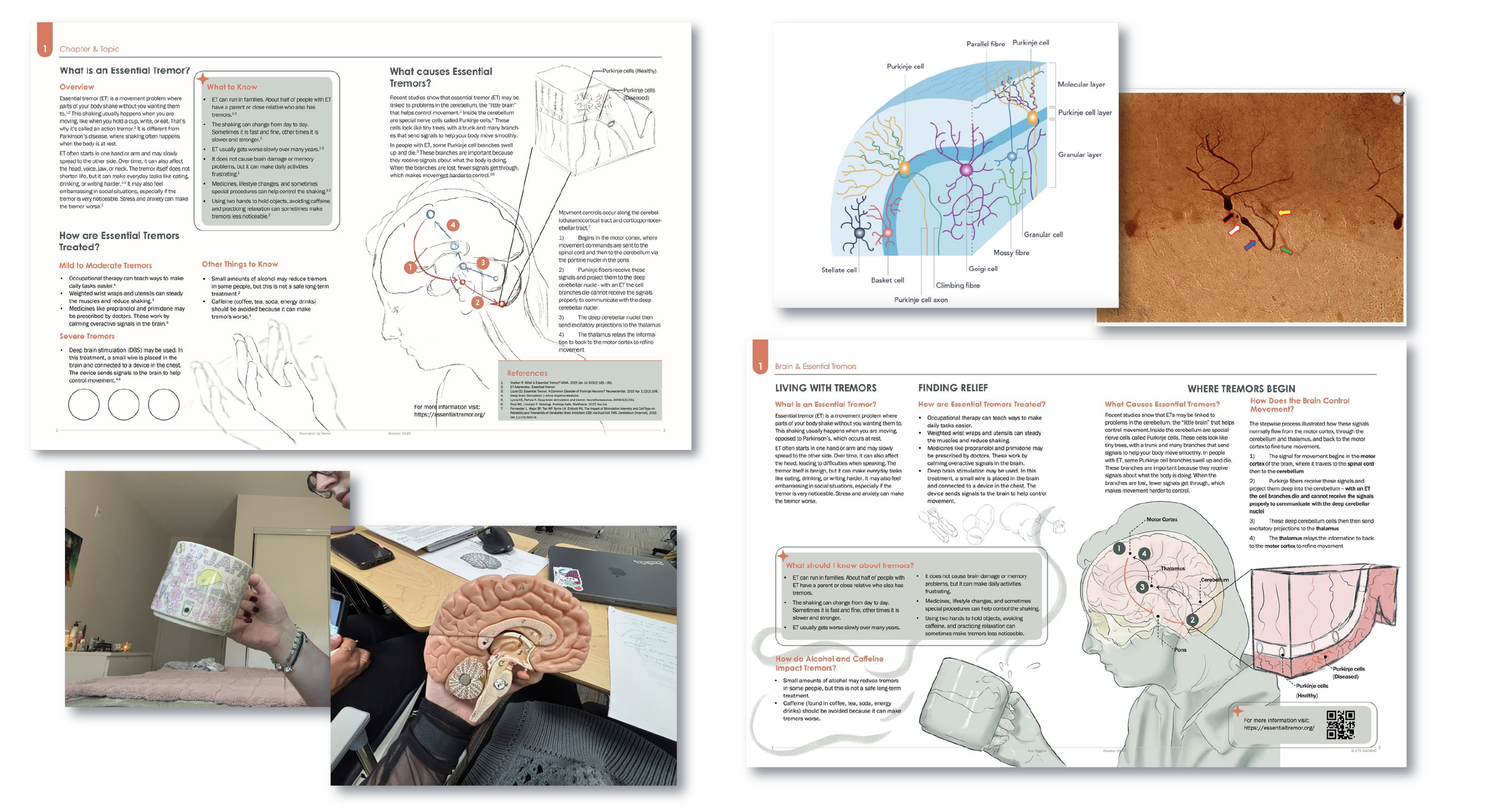
This patient education spread focuses on essential tremor, a condition I chose to visualize because I live with it myself. After being diagnosed at a young age, I often wished for clear, accessible resources that explained what was happening in my body without feeling overwhelming or overly clinical. This project was created with that in mind. Written at a fifth-grade reading level, it explains what tremors are, how essential tremor differs from Parkinson’s disease, and the most common treatment options. It also touches on emerging research into possible causes, giving readers up-to-date information while reinforcing that they’re not alone in navigating their diagnosis.
Tools
Procreate, Illustrator
Type of Work
Coursework
Approach
Spread in a patient education booklet
Client
Shelly Wall (Prof. University of Toronto)
Year
2025
Audience
Lay Audience, Patient focused
Research and Ideation
The development of this patient education spread began with synthesizing current research on essential tremor, with particular attention to emerging evidence surrounding Purkinje cell degeneration. Rather than simply presenting scientific findings, the goal was to identify the concepts most meaningful to patients and translate them into visuals that support understanding without overwhelming the audience. Scientific references informed the anatomical illustrations, ensuring biological accuracy while simplifying complex structures into clear, approachable visual explanations.
Research and design progressed iteratively, with the information hierarchy, illustrations, and layout evolving together to improve readability and guide the viewer through the content. Every design decision balanced scientific accuracy with accessibility, creating a resource that supports patient comprehension while reducing cognitive burden. Working within an established cohort style guide also ensured the spread integrated seamlessly into the larger educational booklet, maintaining a consistent visual language and a calm, reassuring tone throughout.
References
A Guide to Immunostaining the Cerebellum | Proteintech Group. (n.d.). Retrieved October 14, 2025, from https://www.ptglab.com/news/blog/a-guide-to-immunostaining-the-cerebellum/?srsltid=AfmBOopJIEKiPRZlUCiFPN95035ZI5oFOg96Pm5Bq86MfFBbfH0ioHG8
Deep Brain Stimulation | Johns Hopkins Medicine. (n.d.). Retrieved September 19, 2025, from https://www.hopkinsmedicine.org/health/treatment-tests-and-therapies/deep-brain-stimulation
ET Awareness - Essential Tremor. (n.d.). Retrieved September 19, 2025, from https://essentialtremor.org/what-we-do/et-awareness/
Fernandez, L., Major, B. P., Teo, W. P., Byrne, L. K., & Enticott, P. G. (2018). The Impact of Stimulation Intensity and Coil Type on Reliability and Tolerability of Cerebellar Brain Inhibition (CBI) via Dual-Coil TMS. Cerebellum, 17(5), 540–549. https://doi.org/10.1007/S12311-018-0942-5/FIGURES/6
Fujishima, K., Kawabata Galbraith, K., & Kengaku, M. (2018). Dendritic Self-Avoidance and Morphological Development of Cerebellar Purkinje Cells. Cerebellum, 17(6), 701–708. https://doi.org/10.1007/S12311-018-0984-8
Louis, E. D. (2015). Essential Tremor: A Common Disorder of Purkinje Neurons? The Neuroscientist : A Review Journal Bringing Neurobiology, Neurology and Psychiatry, 22(2), 108. https://doi.org/10.1177/1073858415590351
Lyons, K. E., & Pahwa, R. (2008). Deep brain stimulation and tremor. Neurotherapeutics, 5(2), 331. https://doi.org/10.1016/J.NURT.2008.01.004
Martini, F. H., Timmons, M. J., & Tallitsch, R. B. (2007). Human Anatomy (6th Edition) (Sixth). Pearson.
Midsagittal section of the brain: anatomy | Kenhub. (n.d.). Retrieved October 14, 2025, from https://www.kenhub.com/en/library/anatomy/midsagittal-section-of-the-brain
Paul, M. S., & Limaiem, F. (2022). Histology, Purkinje Cells. StatPearls. https://www.ncbi.nlm.nih.gov/books/NBK545154/
Voelker, R. (2025). What Is Essential Tremor? JAMA, 333(2), 181–181. https://doi.org/10.1001/JAMA.2024.19714